Sunday, May 27, 2012

Miniature Bull Terrier: The Breed

             (AKC Terrier Group)
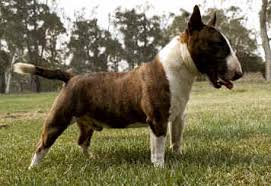
The Miniature Bull Terrier is in every way – except size – exactly like the Bull Terrier. Bull Terriers were first meant to be rough, tough fighting dogs but now exhibit a much gentler, playful personality. As a matter of fact, the jovial nature and the distinctive egg-shaped head of the Bull Terrier made it an apt choice for Target ads and Anhauser Busch’s popular "Spuds McKenzie" ad campaign. The breed can be solid white or colored.


Miniature Bull Terrier AKC Breed Standards


General Appearance
The Miniature Bull Terrier must be strongly built, symmetrical and active, with a keen, determined and intelligent expression. He should be full of fire, having a courageous, even temperament and be amenable to discipline.
Size, Proportion, Substance
Height 10 inches to 14 inches. Dogs outside these limits should be faulted. Weight in proportion to height. In proportion, the Miniature Bull Terrier should give the appearance of being square.
Head
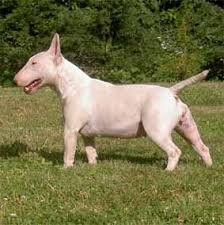
The head should be long, strong and deep, right to the end of the muzzle, but not coarse. The full face should be oval in outline and be filled completely up, giving the impression of fullness with a surface devoid of hollows or indentations, i.e., egg shaped. The profile should curve gently downwards from the top of the skull to the tip of the nose. The forehead should be flat across from ear to ear. The distance from the tip of the nose to the eyes should be perceptibly greater than that from the eyes to the top of the skull. The underjaw should be deep and well defined.
To achieve a keen, determined and intelligent expression, the eyes should be well sunken and as dark as possible with a piercing glint. They should be small, triangular and obliquely placed, set near together and high up on the dog's head. The ears should be small, thin and placed close together, capable of being held stiffly erect when they point upwards. The nose should be black, with well developed nostrils bent downwards at the tip. The lips should be clean and tight. The teeth should meet in either a level or scissor bite. In the scissor bite, the top teeth should fit in front of and closely against the lower teeth. The teeth should be sound, strong and perfectly regular.


Neck, Topline, Body
The neck should be very muscular, long, and arched; tapering from the shoulders to the head, it should be free from loose skin. The back should be short and strong with a slight arch over the loin. Behind the shoulders there should be no slackness or dip at the withers. The body should be well rounded with marked spring of rib. The back ribs deep. The chest should be broad when viewed from in front. There should be great depth from withers to brisket, so that the latter is nearer to the ground than the belly. The underline, from the brisket to the belly, should form a graceful upward curve. The tail should be short, set on low, fine, and should be carried horizontally. It should be thick where it joins the body, and should taper to a fine point.
Forequarters
The shoulders should be strong and muscular, but without heaviness. The shoulder blades should be wide and flat and there should be a very pronounced backward slope from the bottom edge of the blade to the top edge. The legs should be big boned but not to the point of coarseness. The forelegs should be of moderate length, perfectly straight, and the dog must stand firmly up on them. The elbows must turn neither in nor out, and the pasterns should be strong and upright.
Hindquarters
The hind legs should be parallel when viewed from behind. The thighs are very muscular with hocks well let down. The stifle joint is well bent with a well developed second thigh. The hind pasterns should be short and upright.
Feet - The feet are round and compact with well arched toes like a cat.
Coat - The coat should be short, flat and harsh to the touch with a fine gloss. The dog's skin should fit tightly.
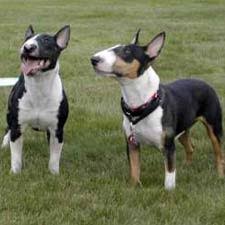
Color - For white, pure white coat. Markings on head and skin pigmentation are not to be penalized. For colored, any color to predominate.
Gait - The dog shall move smoothly, covering the ground with free, easy strides. Fore and hind legs should move parallel to each other when viewed from in front or behind, with the forelegs reaching out well and the hind legs moving smoothly at the hip and flexing well at the stifle and hock. The dog should move compactly and in one piece but with a typical jaunty air that suggests agility and power.
Faults
Any departure from the foregoing points shall be considered a fault, and the seriousness of the fault shall be in exact proportion to its degree.
Approved May 14, 1991
Effective January 1, 1992


Miniature Bull Terrier Health Issues


Miniature Bull Terriers are generally quite healthy, but there are hearing, eye, skin, kidney, heart and knee problems in some dogs:
Deafness occurs in both coloured and white Bull Terrier (Miniature). Puppies can be born unilaterally deaf (deaf in one ear) or bilaterally (deaf in both ears.) Deaf dogs should not be bred due to deafness being hereditary.  BEAP (or BAER) testing is done on puppies prior to sale to discover which puppies have hearing problems.

Bull Terrier (Miniature) are also susceptible to having luxating patellas. This is a knee problem common in small dogs. It can be treated by surgery.
Polycystic kidney disease (PKD) and Bull Terrier hereditary nephritis (BTHN) are autosomal dominant diseases. PKD is diagnosed by Ultrasonic scan by a specialist veterinarian. BTHN is diagnosed by a UPC test. Dogs with a score of .3 or below are considered clear of the disease. Clearing breeding stock prior to use ensures that progeny are not affected with the disease.
Miniature Bull Terriers are also susceptible to eye problems such as primary lens luxation. PLL is a late onset disease which typically affects dogs between the ages of 3 and 7. Younger and older cases are known. During September 2009 a definitive DNA test was released by the Animal Health Trust. This test gives three results: Clear, Carrier, Affected.
Aortic valve stenosis and mitral valve dysplasia are heart diseases. Diagnosis is made by colour doppler echocardiography scanning by a specialist veterinarian.
The skin of a Miniature can be a problem. Pyotraumatic dermatitis (hot spots), allergic reactions, and hives can be problematic. This is typically due to feeding a processed diet high in grains. Breeders with experience find that changing the dogs diet to unprocessed raw foods eliminates skin problems in the breed.


Miniature Bull Terrier Temperament


Like the Bull Terriers, Minis are loving and, like many terrier breeds, can be stubborn at times; but despite this they make great dogs for people with limited space.
Miniature Bull Terriers are known to be stubborn and courageous. They do not seem to realize their size, however, because even if confronting an enormous dog they will not back down. However, with the right training, confrontations can be avoided. They are very energetic and playful. They love people, but often do not get along with other pets. They are variable around other dogs, and young children must be warned to treat them carefully.  The temperament should be full of fire and courageous, but even and amenable to discipline.


Did You Know?

  • There used to be three types of Bull Terrier: Toy, Miniature, and Standard. The toy dog, however, fell out of favor and there are now only Miniature and Standard size Bull Terriers.
  • The Miniature Bull Terrier originated in England.
  • The Miniature Bull Terrier was accepted in Miscellaneous Class in 1963 and accepted as a breed in 1991.
  • The Miniature Bull Terrier is AKC’s 133rd breed.
  • In early 19th century the Bulldog & now the extinct White English Terrier were interbred to produce the "Bull and Terrier" later known as the Bull Terrier.
  • These dogs have a high activity level, they are smart and creative, indeed they are independent thinkers.


Miniature Bull Terrier History


The Miniature Bull Terrier is no newcomer to the world of purebred dogs. As a matter of fact, for over eighty years he has been highly prized as a distinctive small dog noted, among other things, for tenacity and remarkable courage. He is a sturdy chap, muscular, active, and full of fire but withal good tempered and amenable to discipline.
Miniature beginnings date back to the early 19th century when the Bulldog and the now extinct White English Terrier were interbred to produce the "Bull and Terrier" later known as the Bull Terrier.
Possessed of such a heritage, it is small wonder that the earliest specimens came in a wide range of sizes. There were Toys that weighed from four to seven pounds, medium sized ones of some fifteen and sixteen pounds, as well as the more usual sort resembling the full-sized Bull Terrier of this day. The small dog came in various colors; some black-patched, a few blue, and others pure white.
The Toys were exhibited abroad up to about 1914, but they elicited scant response from the fanciers because their type was poor. Dogs of medium or miniature size fared better since particularly in eyes and foreface they more closely approximated the type desired. This has been exactly what the fanciers have been aiming for, namely, a down-faced, smaller dog weighing around sixteen pounds and identical in make and shape and every single feature to the full-sized Bull Terrier.
The Miniature Bull Terrier became eligible to be shown in the Miscellaneous Class in 1963, and was accepted as a breed in 1991.


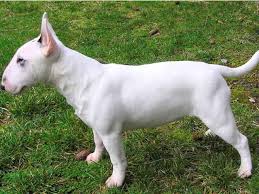
Miniature Bull Terrier Pics


AKC Registered Breeders


Miniature Bull Terrier
Parent Club: Miniature Bull Terrier Club of America
Breeder Referral: Kathy Brosnan, EST 603-679-9507


Saturday, May 26, 2012

Lakeland Terrier: The Breed

           (AKC Terrier Group)
The Lakeland Terrier has a dense, wiry coat with longer hair on the legs and muzzle, often giving him a distinct beard. Small, sturdy and workmanlike, the breed’s narrow frame allows him to squeeze into rocky dens to chase after vermin. While generally a show dog or family companion today, Lakelands can also be found utilizing their natural instincts at earthdog events or digging in the backyard. The breed comes in a variety of colors including blue, black, liver, red and wheaten with or without a patch of color over the back and shoulders called a "saddle".


Lakeland Terrier AKC Breed Standards


General Appearance
The Lakeland Terrier was bred to hunt vermin in the rugged shale mountains of the Lake District of northern England. He is a small, workmanlike dog of square, sturdy build. His body is deep and relatively narrow, which allows him to squeeze into rocky dens. He has sufficient length of leg under him to cover rough ground easily. His neck is long, leading smoothly into high withers and a short topline ending in a high tail set. His attitude is gay, friendly, and self-confident, but not overly aggressive. He is alert and ready to go. His movement is lithe and graceful, with a straight-ahead, free stride of good length. His head is rectangular, jaws are powerful, and ears are V-shaped. A dense, wiry coat is finished off with longer furnishings on muzzle and legs.
Size, Proportion, Substance
The ideal height of the mature dog is 14½ inches from the withers to the ground, with up to a one-half inch deviation either way permissible. Bitches may measure as much as one inch less than dogs. The weight of the well balanced, mature male in hard show condition averages approximately 17 pounds. Dogs of other heights will be proportionately more or less. The dog is squarely built, and bitches may be slightly longer than dogs. Balance and proportion are of primary importance. Short-legged, heavy-bodied dogs or overly refined, racy specimens are atypical and should be penalized. The dog should have sufficient bone and substance, so as to appear sturdy and workmanlike without any suggestion of coarseness.
Head
The expression depends on the dog’s mood of the moment; although typically alert, it may be intense and determined, or gay and even impish. The eyes, moderately small and somewhat oval in outline, are set squarely in the skull, fairly wide apart. In liver or liver and tan dogs, the eyes are dark hazel to warm brown and eye rims are brown. In all other colors, the eyes are warm brown to black and eye rims are dark. The ears are small, V-shaped, their fold just above the top of the skull, the inner edge close to the side of the head, and the flap pointed toward the outside corner of the eye.
The skull is flat on top and moderately broad, the cheeks flat and smooth as possible. The stop is barely perceptible. The muzzle is strong with straight nose bridge and good fill-in beneath the eyes. The head is well balanced, rectangular, the length of skull equaling the length of the muzzle when measured from occiput to stop, and from stop to nose tip. The proportions of the head are critical to correct type. An overlong foreface or short, wedge shaped head are atypical and should be penalized. The nose is black. A "winter" nose with faded pigment is permitted, but not desired. Liver colored noses and lips are permissible on liver coated dogs only. A pink or distinctly spotted nose is very undesirable. The lips are dark. Jaws are powerful. The teeth, which are comparatively large, may meet in either a level, edge to edge bite, or a slightly overlapping scissors bite. Specimens with teeth overshot or undershot are to be disqualified.
Neck, Topline, Body
The neck is long; refined but strong; clean at the throat; slightly arched, and widening gradually and smoothly into the shoulders. The withers, that point at the back of the neck where neck and body meet, are noticeably higher than the level of the back. The topline, measured from the withers to the tail, is short and level. The body is strong and supple. The moderately narrow oval chest is deep, extending to the elbows. The ribs are well sprung and moderately rounded off the vertebrae. The Lakeland Terrier is a breed of moderation. A barrel-chested, big-bodied dog or one which is slab-sided and lacking substance is atypical and should be penalized. The loins are taut and short, although they may be slightly longer in bitches. There is moderate tuck-up. The tail is set high on the back. It is customarily docked so that when the dog is set up in show position, the tip of the tail is level with the occiput. In carriage, it is upright and a slight curve toward the head is desirable. Behind the tail is a well-defined, broad pelvic shelf. It is more developed in dogs than in bitches. The tail tightly curled over the back is a fault.
Forequarters
The shoulders are well angulated. An imaginary line drawn from the top of the shoulder blade should pass through the elbow. The shoulder blade is long in proportion to the upper arm, which allows for reasonable angulation while maintaining the more upright "terrier front." The musculature of the shoulders is flat and smooth. The elbows are held close to the body, standing or moving. The forelegs are strong, clean and straight when viewed from the front or side. There is no appreciable bend at the pasterns. The feet are round and point forward, the toes compact and strong. The pads are thick and black or dark gray, except in liver colored dogs where they are brown. The nails are strong and may be black or self-colored. Dewclaws are removed.
Hindquarters
The thighs are powerful and well muscled. The hind legs are well angulated, but not so much as to affect the balance between front and rear, which allows for smooth efficient movement. The stifles turn neither in nor out. The distance from the hock to the ground is relatively short and the line from the hock to toes is straight when viewed from the side. From the rear the hocks are parallel to each other. Feet same as front. Dewclaws, if any, are removed.
Coat
Two-ply or double, the outer coat is hard and wiry in texture, the undercoat is close to the skin and soft and should never overpower the wiry outer coat. The Lakeland is hand stripped to show his outline. (Clipping is inappropriate for the show ring.) The appearance should be neat and workmanlike. The coat on the skull, ears, forechest, shoulders and behind the tail is trimmed short and smooth. The coat on the body is longer (about one-half to one inch) and may be slightly wavy or straight. The furnishings on the legs and foreface are plentiful as opposed to profuse and should be tidy. They are crisp in texture. The legs should appear cylindrical. The face is traditionally trimmed, with the hair left longer over the eyes to give the head a rectangular appearance from all angles, with the eyes covered from above. From the front, the eyes are quite apparent, giving the Lakeland his own unique mischievous expression.
Color
The Lakeland Terrier comes in a variety of colors, all of which are equally acceptable. Solid colors include blue, black, liver, red, and wheaten. In saddle marked dogs, the saddle covers the back of the neck, back, sides and up the tail. A saddle may be blue, black, liver, or varying shades of grizzle. The remainder of the dog (head, throat, shoulders, and legs) is a wheaten or golden tan. Grizzle is a blend of red or wheaten intermixed in varying proportions with black, blue or liver.


Gait
Movement is straightforward and free, with good reach in front and drive behind. It should be smooth, efficient and ground-covering. Coming and going, the legs should be straight with feet turning neither in nor out; elbows close to the sides in front and hocks straight behind. As the dog moves faster he will tend to converge toward his center of gravity. This should not be confused with close movement.

Disqualifications
Teeth overshot or undershot.
Approved January 15, 1991
Effective February 27, 1991


Lakeland Terrier Health Issues


 The Lakeland Terrier, which has an average lifespan of 12 to 16 years, is prone to minor health concerns such as lens luxation and distichiasis, and major health issues like Legg-Perthes disease and von Willebrand's Disease (vWD). A thorough eye exam is recommended for the Lakeland Terrier.


 Lakeland Terrier Temperament


The dogs are friendly, bold, and confident.  Shyness is very atypical, as is aggressiveness.  Very intelligent and independent minded, they are quick to learn and easy to train though Lakelands often exhibit 'selective deafness' when their interest level is aroused.  The Lakeland is quite receptive to crate training.  As with most terriers, the Lakeland is energetic; daily exercise and playtimes are a must, lest this active dog seek out other outlets for their energy, with undesirable results for the ownerThe typical Lakeland Terrier is bold, gay and friendly, with a confident, cock-of-the-walk attitude. Shyness, especially shy-sharpness, in the mature specimen is to be heavily penalized. Conversely, the overly aggressive, argumentative dog is not typical and should be strongly discouraged.


Did You Know?


  • One of two dogs to win both Westminster in New York and Crufts in London was a Lakeland Terrier named Champion Stingray of Derryabah (1967).
  • The Lakeland Terrier breed was developed to protect sheep from fox.
  • The breed is derived like the Welsh Terrier from the now extinct Old English Black and Tan Terrier. Other breeds including Wire Fox Terrier, Border Terrier, Bedlington Terriers and the early Dandie Dinmonts are believed to have contributed to the breed’s development.
  • The breed has been known by a variety of names including Patterdale, Fell, Cumberland and Westmoreland terrier.
  • The birthplace of the Lakeland Terrier is Cumberland County in England.
  • The Lakeland Terrier was accepted for registration in the AKC stud book in 1934.


Lakeland Terrier History


The Lakeland Terrier is one of the oldest working terrier breeds still known today. It was bred, raised, and worked in the lake districts of England long before there was a kennel club or an official stud book. The fact that it has been outstripped by many younger terrier breeds is not so much a reflection on its quality as a tribute to the scope of its working ability. The name "Lakeland" indeed, is a modern acquisition. In olden times the breed was known as the Patterdale Terrier.
It is related that long before the days of the great John Peel, or before any packs of hounds were formed, the Lakeland was kept by the farmers in the mountain districts, who, at that time, would form a hunt with a couple of hounds and these terriers. Their work was to destroy the foxes found raiding the sheepfolds. There was sport, but it was not sport for sport’s sake alone. It was a very practical matter.
So great was the courage of the native Lakeland Terriers that they would follow underground for tremendous distances. It is told that, in 1871, Lord Lonsdale had one which crawled 23 feet under rock after an otter. In order to extricate the dog it was necessary to undertake extensive blasting operations. Finally, after three days’ work, they reached the dog, and he was gotten out, none the worse for his experience. Still other dogs have been known to be locked underground for ten or twelve days and have been taken out alive. Others have paid the penalty.
Cumberland was the birthplace of the Lakeland Terrier. This is a particularly beautiful county, richly studded with lakes, particularly in the southern part. The Bedlington is attributed to neighboring Northumberland county, but it is not difficult to suppose that there was certain traffic in dogs at that time.
The first organized effort to promote the interest of this Cumberland County breed came at the Kersurck show in 1912, when a terrier club was formed. The new club made considerable headway for two years, and then came the outbreak of World War I. Naturally, all civilian activities were under a damper, and little or nothing was heard of the Lakeland Terrier again until 1921. That year fanciers met at Whitehaven, in Cumberland. According to Thomas Hosking, who later came to the United States and who was one of the nine fanciers who attended, the name Lakeland Terrier was chosen at that meeting. The standard was drawn up at that time, and shortly afterward the breed was made eligible for registration in the stud book of the Kennel Club (England). The Lakeland Terrier was accepted for registration in the AKC Stud Book in 1934.
Although a worker for generations, the Lakeland makes a very good appearance in the ring. He has a dense, weather-resisting coat, strong jaws of moderate length, powerful hindquarters, and good legs and feet on a short, strong back. Despite his gameness and courage, he has an attractive, quiet disposition.


Lakeland Terrier Pics


 AKC Registered Breeders


Lakeland Terrier
Parent Club: United States Lakeland Terrier Club
Breeder Referral: See Parent Club website - Breeders List
Breeder Directory: See Parent Club website - Breeders List


Friday, May 25, 2012

Kerry Blue Terrier: The Breed

           (AKC Terrier Group)
Intelligent and game, the Kerry Blue Terrier is truly an all-purpose dog. Originally bred to hunt and retrieve, Kerries can be found today in the show, obedience, agility, herding and earthdog rings. The Kerry’s trademark soft, wavy coat can range from deep slate gray blue to light blue gray. Kerry Blues are born black and, if correct, possess the dominant gene for coat fading. They will fade and acquire their adult color by 18 months.


Kerry Blue Terrier AKC Breed Standards


General Appearance
The typical Kerry Blue Terrier should be upstanding well knit and in good balance, showing a well-developed and muscular body with definite terrier style and character throughout. Correct coat and color are important.  A low-slung Kerry is not typical. 
Size, Proportion, Substance
The ideal Kerry should be 18½ inches at the withers for a dog, slightly less for a bitch. In judging Kerries, a height of 18-19½ inches for a dog, and 17½-19 inches for a bitch, should be given primary preference. Only where the comparative superiority of a specimen outside of the ranges noted clearly justifies it should greater latitude be taken. In no case should it extend to a dog over 20 inches or under 17½ inches, or to a bitch over 19½ inches or under 17 inches. The minimum limits do not apply to puppies. The most desirable weight for a fully developed dog is from 33-40 pounds, bitches weighing proportionately less. A well-developed and muscular body. Legs moderately long with plenty of bone and muscle.
Head
Long, but not exaggerated, and in good proportion to the rest of the body. Well balanced. Eyes-Dark, small, not prominent, well placed and with a keen terrier expression. Anything approaching a yellow eye is very undesirable. Ears-V-shaped, small but not out of proportion to the size of the dog, of moderate thickness, carried forward close to the cheeks with the top of the folded ear slightly above the level of the skull. A "dead" ear, houndlike in appearance, is very undesirable. Skull-Flat, with very slight stop, of moderate breadth between the ears, and narrowing very slightly to the eyes. Foreface full and well made up, not falling away appreciably below the eyes but moderately chiseled out to relieve the foreface from wedginess. Little apparent difference between the length of the skull and foreface. Jaws deep, strong and muscular. Cheeks-Clean and level, free from bumpiness. Nose-Black, nostrils large and wide. Teeth-Strong, white and either level or with the upper (incisors) teeth slightly overlapping the lower teeth. An undershot mouth should be strictly penalized.


Neck, Topline, Body
Neck-Clean and moderately long, gradually widening to the shoulders upon which it should be well set and carried proudly. Back short, strong and straight (i.e., level), with no appearance of slackness. Chest deep and of moderate breadth. Ribs fairly well sprung, deep rather than round. A slight tuck-up. Loin short and powerful. Tail should be set on high, of moderate length and carried gaily erect, the straighter the tail the better.
Forequarters
Shoulders fine, long and sloping, well laid back and well knit. The elbows hanging perpendicularly to the body and working clear of the side in movement. The forelegs should be straight from both front and side view. The pasterns short, straight and hardly noticeable. Feet should be strong, compact, fairly round and moderately small, with good depth of pad free from cracks, the toes arched, turned neither in nor out, with black toenails.
Hindquarters
Strong and muscular with full freedom of action, free from droop or crouch, the thighs long and powerful, stifles well bent and turned neither in nor out, hocks near the ground and, when viewed from behind, upright and parallel with each other, the dog standing well up on them.
Coat
Correct coat is important it is to be soft, dense and wavy. A harsh, wire or bristle coat should be severely penalized. In show trim the body should be well covered but tidy, with the head (except for the whiskers) and the ears and cheeks clear.
Color
Color is important.  The correct mature color is any shade of blue gray or gray blue from the deep slate to light blue gray, of a fairly uniform color throughout except that distinctly darker to black parts may appear on the muzzle, head, ears, tail and feet. Kerry color, in its process of "clearing," changes from an apparent black at birth to the mature gray blue or blue gray. The color passes through one or more transitions--involving a very dark blue (darker than deep slate), shades or tinges of brown, and mixtures of these, together with a progressive infiltration of the correct mature color.   The time needed for this “clearing” process varies with each dog.  Small white markings are permissible.  Black on the muzzle, head, ears, tail and feet is permissible at any age.  A black dog 18 months of age or older is never permissible in the show ring and is to be disqualified. Disqualification - A black dog 18 months of age or older is to be disqualified. (White markings on a black dog 18 months of age or older does not constitute clearing or mature color and the dog is to be disqualified.)
Gait
Full freedom of action. The elbows hanging perpendicularly to the body and working clear of the sides in movement; both forelegs and hind legs should move straight forward when traveling, the stifles turning neither in nor out.
Disqualifications
A black dog 18 months of age or older is to be disqualified. (White markings on a black dog 18 months of age or older does not constitute clearing or mature color and the dog is to be disqualified.)
Approved October 10, 2005
Effective January 1, 2006


Kerry Blue Terrier Health Issues


 Kerries are fairly healthy, however there are some genetic disorders that are prevalent in the breed. They are prone to eye problems such as Keratoconjunctivitis sicca (dry eyes), cataracts, and entropion. They sometimes get cysts or cancerous growths in their skin, but these are rarely malignant. Hip dysplasia, hypothyroidism, cryptorchidism have also been reported. Progressive neuronal abiotrophy (PNA) is also seen. This condition is also referred to as Cerebellar cortical abiotrophy (CCA) or Cerebellar Abiotrophy (CA). Another skin-related health issue is spiculosis. This is a skin disorder that produces abnormally thick hairs that are also called thorns, spikes or bristles.


Kerry Blue Terrier Temperament

 Kerry Blue Terriers are strong-headed and highly spirited. They have always been loyal and affectionate towards their owners and very gentle towards children but were often considered downright mean toward other animals including other dogs. In the early days of competitive dog showing the Irish Kennel Club required Kerries had to pass a "gameness" test, known as Teastas Mor certification, before they were deemed worthy of being judged. These tests included catching rabbits and bringing a badger to bay in its set. They are fast, strong, and intelligent. They do well in obedience, dog agility, sheep herding, and tracking. They have been used as police dogs in Ireland. Modern breeders have attempted to retain high spirits whilst breeding out aggression.


Did You Know?


  • It is thought that the peasantry of Ireland developed the Kerry as an answer to the nobility using Irish Wolfhounds. The Irish Wolfhounds were used to protect noble hunting grounds from poachers. The Kerry was used to help the peasantry to silently hunt the noble hunting grounds.
  • The Kerry Blue Terrier originated in Ireland.
  • The Kerry is an all-round working and utility terrier. The breed was used in Ireland and England for hunting small game and birds, and for retrieving from land and water.
  • The Kerry’s most distinguishing characteristic is its coat. Described in the breed standard as "soft, dense, and wavy," it does not shed and can be tolerated by many people with pet allergies.
  • The first Kerry Blues in North America were five pets imported in 1918-9; the breed first appeared at shows in the very early 1920’s.
  • Kerry Blues are born black and, if correct, have the dominant gene for coat fading. The color begins to fade to gray and acquires its adult solid slate gray color by 18 months.


Kerry Blue Terrier History


The Kerry Blue Terrier originated in Ireland, having been noticed first in the mountainous regions of County Kerry, hence the name. The dogs had been pure-bred in that section for over a hundred years.
Gentle, lovable, and intelligent, the Kerry is an all-round working and utility terrier, used in Ireland and England for hunting small game and birds, and for retrieving from land and water. He is used quite successfully, too, for herding sheep and cattle.
These dogs were always considered as working and sporting terriers, no thought being given to them as a bench-show dog. However, after the formation of the Republic, they began to appear on the bench and met with quick favor. The first few came out at the Dublin show The Kerry in Ireland is fostered by the Irish Blue Terrier Club of Dublin, organized by H. G. Fotterell.
English fanciers were quick to realize the Kerries’ possibilities if properly groomed, and the Kennel Club there provided regular classification for them. Their rise to popularity was almost instant, and each show brought out increasing numbers of entries.
The Blue Terrier Club of England, organized by Captain Watts Williams, is the supporting organization back of the Blues for England. The English standard is with a few minor exceptions identical with the American standard in that coats must be trimmed.
There is more or less conjecture as to who imported the first Kerry and where it was first shown in this country. However, it appears that the first important show at which Kerries appeared was at Westminster in 1922. For two years following their initial exhibition at Madison Square Garden they were relegated to the Miscellaneous Class, but in 1924 they were officially recognized by the American Kennel Club as a breed and given championship rating.
During the Westminster show of 1926, a group of fanciers met at the Waldorf-Astoria in New York City and organized the Kerry Blue Terrier Club of America. Their stated purpose was to encourage the breeding of the Kerry, assist its fanciers, adopt a standard, and foster both the utilitarian and sporting qualities of the dog (with aim toward field trials as well as dog shows).


Kerry Blue Terrier Pics


AKC Registered Breeders


Kerry Blue Terrier
Parent Club: United States Kerry Blue Terrier Club, Inc.
Breeder Referral: Barbara Beuter, 25818 Tamra Ct, Leesburg, FL 34748; EST (352) 787-7055
Breeder Directory: website


Thursday, May 24, 2012

Dandie Dinmont Terrier: The Breed

          (AKC Terrier Group)
The Dandie Dinmont Terrier is characterized by his long, low body and "scimitar" tail, which looks like a curved sword, as well as his large soulful eyes and fluffy head of hair. Though small in stature, the Dandie has the character of a big dog, possessing confidence, intelligence and an independent nature. The breed’s allowable coat colors are described as "pepper" and "mustard."


Dandie Dinmont AKC Terrier Breed Standards


General Appearance
Originally bred to go to ground, the Dandie Dinmont Terrier is a long, low-stationed working terrier with a curved outline. The distinctive head with silken topknot is large but in proportion to the size of the dog. The dark eyes are large and round with a soft, wise expression. The sturdy, flexible body and scimitar shaped tail are covered with a rather crisp double coat, either mustard or pepper in color.
Size, Proportion, Substance
Height is from 8 to 11 inches at the top of the shoulders. Length from top of shoulders to root of tail is one to two inches less than twice the height. For a dog in good working condition, the preferred weight is from 18 to 24 pounds. Sturdily built with ample bone and well developed muscle, but without coarseness. The overall balance is more important than any single specification.
Head
The head is strongly made and large, but in proportion to the dog’s size. Muscles are well developed, especially those covering the foreface. The expression shows great determination, intelligence and dignity. The eyes are large, round, bright and full, but not protruding. They are set wide apart and low, and directly forward. Color, a rich dark hazel. Eye rims dark. The ears are set well back, wide apart and low on the skull, hanging close to the cheek, with a very slight projection at the fold. The shape is broad at the base, coming almost to a point. The front edge comes almost straight down from base to tip; the tapering is primarily on the back edge. The cartilage and skin of the ear are rather thin. The ear’s length is from three to four inches. The skull is broad between the ears, gradually tapering toward the eyes, and measures about the same from stop to occiput as it does from ear to ear. Forehead (brow) well domed. Stop well defined. The cheeks gradually taper from the ears toward the muzzle in the same proportion as the taper of the skull. The muzzle is deep and strong. In length, the proportions are a ratio of three (muzzle) to five (skull). The nose is moderately large and black or dark colored. The lips and inside of the mouth are black or dark colored. The teeth meet in a tight scissors bite. The teeth are very strong, especially the canines, which are an extraordinary size for a small dog. The canines mesh well with each other to give great holding and punishing power. The incisors in each jaw are evenly spaced and six in number.


Neck, Topline, Body
The neck is very muscular, well developed and strong, showing great power of resistance. It is well set into the shoulders and moderate in length. The topline is rather low at the shoulder, having a slight downward curve and a corresponding arch over the loins, with a very slight gradual drop from the top of the loins to the root of the tail. Both sides of the backbone well muscled. The outline is a continuous flow from the crest of the neck to the tip of the tail. The body is long, strong and flexible. Ribs are well sprung and well rounded. The chest is well developed and well let down between the forelegs. The underline reflects the curves of the topline. The tail is 8 to 10 inches in length, rather thick at the root, getting thicker for about four inches, then tapering off to a point. The set-on of the tail is a continuation of the very slight gradual drop over the croup. The tail is carried a little above the level of the body in a curve like a scimitar. Only when the dog is excited may the tip of the tail be aligned perpendicular to its root.
Forequarters
There should be sufficient layback of shoulder to allow good reach in front; angulation in balance with hindquarters. Upper arms nearly equal in length to the shoulder blades, elbows lying close to the ribs and capable of moving freely. The forelegs are short with good muscular development and ample bone, set wide apart. Feet point forward or very slightly outward. Pasterns nearly straight when viewed from the side. Bandy legs and fiddle front are objectionable.
Hindquarters
The hind legs are a little longer than the forelegs and are set rather wide apart, but not spread out in an unnatural manner. The upper and lower thighs are rounded and muscular and approximately the same length; stifles angulated, in balance with forequarters. The hocks are well let down and rear pasterns perpendicular to the ground.
Feet
The feet are round and well cushioned. Dewclaws preferably removed on forelegs. Rear feet are much smaller than the front feet and have no dewclaws. Nails strong and dark; nail color may vary according to the color of the dog. White nails are permissible. Flat feet are objectionable.
Coat
This is a very important point: The hair should be about two inches long; the body coat is a mixture of about 2/3 hardish hair with about 1/3 soft hair, giving a sort of crisp texture. The hard is not wiry. The body coat is shortened by plucking. The coat is termed pily or pencilled, the effect of the natural intermingling of the two types of hair. The hair on the underpart of the body is softer than on the top.
The head is covered with very soft, silky hair, the silkier the better. It should not be confined to a mere topknot but extends to cover the upper portion of the ears, including the fold, and frames the eyes. Starting about two inches from the tip, the ear has a thin feather of hair of nearly the same color and texture as the topknot, giving the ear the appearance of ending in a distinct point. The body of the ear is covered with short, soft, velvety hair. The hair on the muzzle is of the same texture as the foreleg feather. For presentation, the hair on the top of the muzzle is shortened. The hair behind the nose is naturally more sparse for about an inch.
The forelegs have a feather about two inches long, the same texture as the muzzle. The hind leg hair is of the same texture but has considerably less feather. The upper side of the tail is covered with crisper hair than that on the body. The underside has a softer feather about two inches long, gradually shorter as it nears the tip, shaped like a scimitar. Trimming for presentation is to appear entirely natural; exaggerated styling is objectionable.
Color
The color is pepper or mustard.
Pepper ranges from dark bluish black to a light silvery gray, the intermediate shades preferred. The topknot and ear feather are silvery white, the lighter the color the better. The hair on the legs and feet should be tan, varying according to the body color from a rich tan to a very pale fawn.
Mustard varies from a reddish brown to a pale fawn. The topknot and ear feather are a creamy white. The hair on the legs and feet should be a darker shade than the topknot.
In both colors the body color comes well down the shoulders and hips, gradually merging into the leg color. Hair on the underpart of the body is lighter in color than on the top. The hair on the muzzle (beard) is a little darker shade than the topknot. Ear color harmonizes with the body color. The upper side of the tail is a darker shade than the body color, while the underside of the tail is lighter, as the legs. Some white hair on the chest is common.
Gait
Proper movement requires a free and easy stride, reaching forward with the front legs and driving with evident force from the rear. The legs move in a straight plane from shoulder to pad and hip to pad. A stiff, stilted, hopping or weaving gait and lack of drive in the rear quarters are faults to be penalized.
Approved February 9, 1991
Effective March 27, 1991


Dandie Dinmont Terrier Health Issues


Due to the breed's elongated body, there can be back issues within the breed specifically with intervertebral discs in the dog's backs. These discs can sometimes "slip" resulting in spinal disc herniation. Any symptoms relating to this can depend entirely on what part of the dog's back is affected, and can range to paralysis with loss of bladder and bowel control in the worst cases.
Following work by the breed clubs to ensure that any reoccurring health issues are dealt with, there are no especially common conditions affecting the Dandie Dinmont Terrier. However, minor issues affecting the breed can include hypothyroidism, primary closed angle glaucoma and Cushing's syndrome. In order to combat glaucoma in the breed, the breed clubs recommend that Dandies should have a procedure called a gonioscopy conducted on them at regular intervals throughout their lives.  The Dandie is also at slightly higher risk of canine cancer than average.  The average life expectancy of a Dandie Dinmont Terrier is 11–13 years.


Dandie Dinmont Temperament


The breed is tough but usually friendly, and are suitable for older children.  It makes both a good companion and a guard dog, but are among the most docile of the terrier breeds and are usually quite undemanding of their owners.  However they are known for their ability to dig large holes in a short space of time.  They can be trained to be good with cats, but should not be trusted around smaller animals such as hamsters or rats.  They are described as being "very game", in that they are prone to challenging other animals including foxes, and in some cases other dogs.  Independent, determined, reserved and intelligent. The Dandie Dinmont Terrier combines an affectionate and dignified nature with, in a working situation, tenacity and boldness.


Did You Know?


  • Dandie Dinmonts were first recorded as a distinct breed around 1700.
  • This breed was at one time popular with gypsies, but has also been a favorite of the very rich.
  • Queen Victoria owned and loved a Dandie.
  • The Dandie Dinmont is intelligent, fond of children, and an excellent guard.
  • The breed got its name from a funny character in a book written in 1814 by Sir Walter Scott. The character’s name was Dandie Dinmont.
  • The standard for the Dandie Dinmont Terrier was written in Melrose, Scotland in 1876.


Dandie Dinmont History


The Dandie Dinmont Terrier was bred from selected specimens of the rough native terrier of the Border hunters in the Cheviot Hills between England and Scotland and was first recorded as a distinct type of breed about 1700. He was distinguished by his preeminence in hunting the otter and the badger. A direct line of these dogs descended to the farmers in the Teviotdale Hills, where Sir Walter Scott in his travels chanced upon them and made them famous in his Guy Mannering, published in 1814. His character Dandie Dinmont, a farmer (believed to have been a Mr. James Davidson of Hindlee, near Hawick) kept the immortal six: "Auld Pepper," "Auld Mustard," "Young Pepper," "Young Mustard," "Little Pepper," and "Little Mustard." From the time of the popularity of Guy Mannering to the present day, the breed has been known as "Dandie Dinmont’s Terriers."
Today the hunting qualities of the Dandie are not so often required, but his other qualities make him an excellent house dog. He is intelligent, fond of children, and an excellent guard. He has a will of his own and will sometimes obey a command reluctantly, with a look of "I’ll do it, but please don’t make me."
Regular coat care is necessary for a Dandie. Frequent plucking will improve the texture and color of the coat. Only the longest hairs should be removed to keep the double coat and penciled appearance. If the coat is neglected for a long period, it may be necessary to strip it down close to the skin. This will leave only undercoat and the Dandie may appear white. It can take months for the coat to grow in to proper length and texture after stripping.
Dandies fit in anywhere, either in a rough-and-tumble out-of-doors life or in the confines of a city apartment. They are in ideal size, between 18 and 24 pounds, small enough to fit a small apartment and yet a dog big in character.


Dandie Dinmont Pics 


Dandie Dinmont Terrier
Parent Club: Dandie Dinmont Terrier Club of America, Inc.
Breeder Referral: Janette Shorrock, 3453 Fairwood, Lambertville, MI 48144, 734-854-3511 


Wednesday, May 23, 2012

Cesky Terrier: The Breed

           (AKC Terrier Group)
http://www.nextdaypets.com/directory/breeds/images/1100069.jpgThe Cesky Terrier is a well-muscled, short legged and well-pigmented hunting terrier that was developed to be worked in packs. The breed originated in the Czech Republic and is considered one of the country’s national breeds. As such, it has been featured on postage stamps, on television, in books and even in a movie. The Cesky has natural drop ears, a natural tail, and sports a soft, long, silky coat in shades of gray from charcoal to platinum.


Cesky Terrier AKC Breed Standards

General Appearance
The Cesky Terrier was developed to be a well-muscled, short legged and well-pigmented hunting terrier that could be worked in packs. The Cesky Terrier has natural drop ears and a natural tail. The Cesky is longer than it is tall and has a topline that rises slightly higher over the loin and rump. It sports a soft, long, silky coat in shades of gray from Charcoal to Platinum. The correct coat is clipped to emphasize a slim impression. The hallmarks of the breed should be unique unto itself with a lean body and graceful movement. They are reserved towards strangers, loyal to their owners, but ever keen and alert during the hunt.
Size, Proportion Substance
Ideal Measurements
Height – Height at withers 10 - 13 inches.
Weight – Weight is ideally between 16 and 22 pounds, bitches slightly less, (suggested to be no less than 14 pounds and no more than 24 pounds) however, no Cesky in good condition and otherwise well balanced shall be penalized for being only slightly outside the suggested weight.
Length – The length of body, measured from sternum to buttocks ideally between 15 and 17 inches. To be in a ratio of approximately 1 1/2 (Length) to 1 (Height). The overall balance is more important than any single specification.
Girth of thorax (behind elbows) – The girth of the body measured at the thorax, behind the elbows ideally is 17 to 18 inches.

Head
Head – Head is about 7 to 8 inches long, 3 to 4 inches wide and is shaped like a long, blunt wedge. The plane of the forehead forms a slight but definite stop with the bridge of the nose. The breadth between the ears is slightly larger for a dog than a bitch. The head should join the neck smoothly.
Eyes - Almond shaped of medium size. Slightly deep set with a friendly expression. The color is brown or dark brown.
Ears - Medium size, dropping in such a way to well cover the orifice. Ears are set rather high with forward edge lying close to the cheek. Shaped like a triangle, with the shorter side of the triangle at the fold of the ear.
Skull – Skull is shaped like a blunt wedge with the broadest part between the ears which tapers moderately towards the supraorbital ridges. Occipital protuberance easy to palpate, cheek bones moderately prominent. Frontal furrow only slightly marked. A shallow indentation running down the brows, and joining the muzzle with a moderate stop.
Muzzle - Nasal Bridge straight. Narrow foreface undesirable.
Stop – Not accentuated but apparent.
Nose – Dark and well developed. The color is black.
Teeth – Set square in a strong jaw, sound and regular, and of good size. Either scissor or level bite is expectable. Complete dentition preferred.
Neck, Topline and Body
Neck – Well muscled and strong. Medium-long, carried in a slight arch. Set firmly on the shoulders.
Topline – Not straight but with a slight rise over the loin and rump.
Body – Fully muscled, longer than high. Withers not very pronounced with the neck set rather high. Rump is strongly developed, muscular; pelvis moderately slanting with the hip bones often slightly higher than the withers.
Belly – Ample and slightly tucked up. Flanks well fitted.
Chest – More cylindrical than deep.
Ribs – Well sprung.
Loins – Relatively long, muscular, broad and slightly rounded.
Tail – The ideal length is 7 to 8 inches. Set following the line of the rump. Tail may be carried downward or with a slight bend at tip; or carried saber shaped horizontally or higher. All of these tail carriages are considered correct with none having preference over the other. Curled squirrel tail penalized.
Forequarters
Shoulder – Muscular, well laid back and powerful.
Elbows – Should fit closely to the sides and be neither loose or tight.
Forelegs – Short, straight, well boned and parallel. Dewclaws may be present.
Forefeet – Large, well-arched toes with strong nails and well-developed pads.
Hindquarters
Hindlegs – Strong, well-muscled and longer than the forelegs.
Thigh - Longer in proportion to the lower leg with stifle well bent.
Hock Joint - Strong and well developed. Well let down and parallel to each other. Lower leg is straight from hock to heel.
Hindfeet – As front but smaller.
Coat
Long, fine but slight texture. Furnishings slightly wavy with a silky gloss. Shorter hair can have more curl. Not overdone with too much furnishings.
Clipping for presentation:
Head and neck
On the foreface, the hair is not to be trimmed except for cleaning up long hair to form a beard and eyebrows. The eyebrows should angle from the outside corner of the eye and work into the fall that is left long between the eyes. The beard is trimmed at an angle from the underside of the eye to the corner of the mouth and around the lower jaw. The hair on the cheeks and underside of the neck is clipped quite short, ¼ inch long. The hair on the upper side of the neck is trimmed to about ½ to 1 inch long.
Chest and Forequarters
The short hair on the underside of the neck is continued down the chest. Long furnishings begin at the level of where the front leg couples with the body and continue across the front of the dog in a straight line that is not blended into the short hair of the upper chest and neck. The short hair is continued over the shoulder muscles and stops where the body ties into the forequarters of the dog. The top lateral portion of the front leg is also clipped short in a U shape as to show off the powerful muscle of the upper leg. The rest of the hair on the front leg is grown out in long furnishings that stop at ground level.
Body
The hair on the body is clipped to ½ to 1 inch to form a saddle starting at the withers and ending in a V shape on the tail. The longer hair on the back is blended into shorter ¼ to ½ inch hair which covers the sides of the dog. Long furnishings start at the level of the elbow and continue across the lower portion of the ribcage to the tuck-up.
Hindquarters
The hair covering the heavy muscling of the thigh from the point of the hipbone to the top of the hock is clipped short, ¼ inch. Long furnishings start at the tuck-up run down the front of the hind leg and across to the hock. The furnishings continue down from the hock to ground level. The hair covering the vent and tail is clipped short 1/8 to 1/4 inch except for a V shape of longer hair from the back saddle worked into the very top part of the tail where it meets the body.
Overall Appearance
The transition between clipped and unclipped areas should be pleasing to the eye and never abrupt. The final haircut should show off the strong, muscled Cesky Terrier.
Color
All puppies are born black, or black and tan.
In mature dogs, 3 years or older, the correct color is any shade of gray from charcoal to platinum gray. Black may appear on the head, ears, feet and tail. White, brown and yellow markings are permitted on the head, beard, cheeks, neck, chest, limbs and around the vent. A white collar or white tip is permitted on the tail. The base color must always be predominant.
Gait
The action should be free and even, with good reach in both the front and back, covering the ground effortlessly. This is a working terrier, which must have agility, freedom of movement and endurance to work.
Approved: October 18, 2010
Effective: June 30, 2011


Cesky Terrier Health Issues


This breed occasionally suffers from the Scotty Cramp, a minor problem causing awkward movement, but that is not painful or life threatening.

Cesky Terrier Temperament


Balanced, non-aggressive. Not to be sparred in the show ring. Can be reserved toward strangers. A pleasant dog that is not as excitable as other terrier breeds but always ready to give chase to something of interest. When working they can be silent but right on target and also able to work underground in burrows and scent track game.  Cesky Terriers are reputed to be less active and quieter than other terriers. This may or may not make them suitable pets for families with children.


Did You Know?


  • The Cesky Terrier Dog is AKC’s 172nd breed.
  • The Cesky Terrier Dog has been assigned the Terrier Group designation.
  • The Cesky Terrier has been recorded in the Foundation Stock Service since 1996.
  • The Cesky Terrier was developed by Mr. Frantisek Horak, a Czechoslovakian geneticist.
  • The breed is sometimes called the Czech Terrier, Czesky Terrier or Bohemian Terrier.
  • In its country of origin, the Cesky Terrier has been portrayed on postage stamps.
  • The name is pronounced ches-kee.
  • Cesky Terriers were first imported to the United States in the late 1980's.
  • Geneticist Frantisek Horak crossed the Scottish Terrier with the Sealyham Terrier to create the Cesky Terrier.
  • At the October 2010 Board Meeting the American Cesky Terrier Fanciers Association is the official parent club for the Cesky Terrier and to accept the Cesky Terrier into the AKC Stud Book on June 1, 2011. The breed will be eligible to compete in the Terrier Group beginning June 30, 2011. There will be an open registry for the breed until July 1, 2015.
  • At the October 2007 Board Meeting t he American Cesky Terrier Fanciers Association will serve as the AKC Parent Club to represent the Cesky Terrier and will be eligible to compete in the Miscellaneous Class, effective July 1, 2008.
  • In December 2003 the AKC Board approved the eligibility of some Foundation Stock breeds, which meet certain criteria, for competition in AKC Companion Events (Obedience, Tracking, and Agility), effective January 1, 2004. The breeds must have a minimum of 150 dogs with three generation pedigrees recorded in the FSS®, a national breed club with members in at least 20 states, and an AKC approved breed standard. The breeds that currently meet the criteria are the Irish Red and White Setter, the Cesky Terrier, the Coton de Tulear, the Norwegian Lundehund, the FSS® Black and Tan Coonhound, the Bluetick Coonhound, the American English Coonhound, the Treeing Walker Coonhound, the Peruvian Inca Orchid, the Sloughi, the Dogue de Bordeaux, the Tibetan Mastiff, the Perro de Presa Canario, the Chinook, the Norwegian Buhund, the Swedish Vallhund, the Finnish Lapphund, and the Pyrenean Shepherd. Requests by breed clubs to have their breeds compete in the various Performance Events would be considered on a case-by-case basis.
  • At the November 2003 Board Meeting the Cesky Terrier was approved for competition in AKC Earthdog Tests, effective January 1, 2004. 


  • Cesky Terrier History


    The Cesky Terrier development was started in 1949, and the piebald dog was started in 1954. The Cesky Terrier was recognized by the FCI in 1963, but the Piebald dog is not an FCI breed. Breeds that were developed in the Czech Republic or Slovakia are considered National Breeds. Since the Cesky Terrier has been the most successful of the national breeds, it has been featured on postage stamps, on television, in books and even in a movie.

    Although there was a ban on exporting the breed for a number of years, it still managed to become quite popular in the Scandinavian countries. Now the breed is in most of the European countries as well as England, the United States, Canada, and now Australia.

    Mr. Horak named his kennel "LOVU ZDAR" which means "Successful Hunter" or "Successful Hunting", which was appropriate for his Scotties, later the Sealyham, and finally the Cesky Terrier. He never forgot his idea of combining the Scotty and Sealy, but the war interrupted his plans to try this combination.

    Finally, in 1949, Mr. Horak did a breeding with a Scotty bitch and a Sealyham dog. One pup survived, and as the pup grew up, he started to hunt him. He also reported his breeding of this new breed to the local Terrier Club at that time. Although a brown color is allowed, only a few have been born since the beginning of the breed.

    Unfortunately, this first Cesky Terrier was shot by a careless hunter in 195O. Mr. Horak repeated his breedinq with a Scotty bitch named Scotch Rose and a Sealyham dog named Buganier Urguelle. This litter produced 6 pups and the Cesky Terrier breed had begun. Mr. Horak kept excellent records of all his breedings and started a private registry of the Cesky Terrier.

    Since the genetic pool of the Cesky Terrier was so limited, Mr. Horak decided to introduce some new blood into the breed. A Sealyham was bred into the Cesky Terrier breed in 1984 and 1985, with the permission of the FCI.

    The reasons Mr. Horak developed the Cesky Terrier

    Mr. Horak felt that a combination of the Scottish Terrier and the Sealyham Terrier would make the ideal hunting dog. The darker color of the Scotty and the drop ear of the Sealy were two of the considerations.

    He felt that the two breeds had become too big for hunting in the burrow due to their large chest size. He bred for a narrower chest and a moderately sized head, longer legs than the original breeds, a softer coat, and a temperament that was aggressive in the hunt, but easily handled.

    The Cesky Terrier is used in hunting fox, rabbits, ducks, pheasants, and even wild boar. There is a club of Cesky Terrier owners in the Czech Republic that is just for people who hunt with their Cesky Terriers.

    From the beginning, Mr. Horak decided not to burden the Cesky Terrier with tail docking or the stripping of the coat done in the Scotty and Sealy. He decided that the Cesky Terrier would be clippered (shaved) and the tail would be left undocked. This has made the breed easier to groom as a pet or as a show dog.


    Cesky Terrier Pics


    AKC Registered Breeders

    Cesky Terrier
    Parent Club: American Cesky Terrier Fanciers Association
    Breeder Referral: Barbara Hopler, 9 Woodside Drive, Rockaway, NJ 07866; 973-586-3033; sambarbs@aol.com  


    Tuesday, May 22, 2012

    Cairn Terrier: The Breed

    (AKC Terrier Group)
    Best known as "Toto" from the Wizard of Oz, the Cairn Terrier is a small, hardy working terrier. Originally bred to aid Scottish farmers in ridding their properties of pests, Cairns today use their tenacity to excel in obedience, agility, terrier and tracking trials. Alert and active, this breed possesses a harsh, weather-resistant outer coat that can be any color except white. The hair around the head gives him a general foxy expression.


    Carin Terrier AKC Breed Standards


    General Appearance
    That of an active, game, hardy, small working terrier of the short-legged class; very free in its movements, strongly but not heavily built, standing well forward on its forelegs, deep in the ribs, well coupled with strong hindquarters and presenting a well-proportioned build with a medium length of back, having a hard, weather-resisting coat; head shorter and wider than any other terrier and well furnished with hair giving a general foxy expression.
    Head
    Skull
    - Broad in proportion to length with a decided stop and well furnished with hair on the top of the head, which may be somewhat softer than the body coat. Muzzle - Strong but not too long or heavy. Teeth - Large, mouth neither overshot nor undershot. Nose - Black. Eyes - Set wide apart, rather sunken, with shaggy eyebrows, medium in size, hazel or dark hazel in color, depending on body color, with a keen terrier expression. Ears - Small, pointed, well carried erectly, set wide apart on the side of the head. Free from long hairs.
    Tail
    In proportion to head, well furnished with hair but not feathery. Carried gaily but must not curl over back. Set on at back level.
    Body
    Well-muscled, strong, active body with well-sprung, deep ribs, coupled to strong hindquarters, with a level back of medium length, giving an impression of strength and activity without heaviness.
    Shoulders, Legs and Feet
    A sloping shoulder, medium length of leg, good but not too heavy bone; forelegs should not be out at elbows, and be perfectly straight, but forefeet may be slightly turned out. Forefeet larger than hind feet. Legs must be covered with hard hair. Pads should be thick and strong and dog should stand well up on its feet.
    Coat
    Hard and weather-resistant. Must be double-coated with profuse harsh outer coat and short, soft, close furry undercoat.
    Color
    May be of any color except white. Dark ears, muzzle and tail tip are desirable.
    Ideal Size
    Involves the weight, the height at the withers and the length of body. Weight for bitches, 13 pounds; for dogs, 14 pounds. Height at the withers-bitches, 9½ inches; dogs, 10 inches. Length of body from 14¼ to 15 inches from the front of the chest to back of hindquarters. The dog must be of balanced proportions and appear neither leggy nor too low to ground; and neither too short nor too long in body. Weight and measurements are for matured dogs at two years of age. Older dogs may weigh slightly in excess and growing dogs may be under these weights and measurements.
    Condition
    Dogs should be shown in good hard flesh, well muscled and neither too fat or thin. Should be in full good coat with plenty of head furnishings, be clean, combed, brushed and tidied up on ears, tail, feet and general outline. Should move freely and easily on a loose lead, should not cringe on being handled, should stand up on their toes and show with marked terrier characteristics.
    Faults
    1. Skull - Too narrow in skull.
    2. Muzzle - Too long and heavy a foreface; mouth overshot or undershot.
    3. Eyes - Too large, prominent, yellow, and ringed are all objectionable.
    4. Ears - Too large, round at points, set too close together, set too high on the head; heavily covered with hair.
    5. Legs and Feet - Too light or too heavy bone. Crooked forelegs or out at elbow. Thin, ferrety feet; feet let down on the heel or too open and spread. Too high or too low on the leg.
    6. Body - Too short back and compact a body, hampering quickness of movement and turning ability. Too long, weedy and snaky a body, giving an impression of weakness. Tail set on too low. Back not level.
    7. Coat - Open coats, blousy coats, too short or dead coats, lack of sufficient undercoat, lack of head furnishings, lack of hard hair on the legs. Silkiness or curliness. A slight wave permissible.
    8. Nose - Flesh or light-colored nose.
    9. Color - White on chest, feet or other parts of body.
    Approved May 10, 1938


    Carin Terrier Health Issues


    These dogs are generally healthy and live on average about 12 to 14 years. Yet breeders, owners and veterinarians have identified several health problems that are significant for Cairns. Some of these diseases are hereditary while others occur as a result of non-specific factors (i.e. infections, toxins, injuries, or advanced age).
    Some of the more common hereditary health problems found in the Cairn are:
    13 year old Carin Terrier
    Currently, the Cairn Terrier Club of America along with the Institute for Genetic Disease Control in Animals maintain an open registry for Cairn Terriers in hopes of reducing the occurrence of hereditary diseases within the breed. Breeders voluntarily submit their dogs' test results for research purpose, as well as for use by individuals who seek to make sound breeding decisions. By using Dog-DNA.com Breed Test services you're insuring that genetic defaults in the breed are weeded out, overall making the breed more healthy and stronger.


    Carin Terrier Temperament


    Cairn Terriers are adventurous, intelligent, strong, loyal, and tough--not a delicate lapdog. Like most terriers, they love to dig after real or imagined prey. They are vermin hunters. Cairns have potential aggression toward other animals with strong chasing instincts but will co-exist with them more readily than some other terriers. However, strange animals may be a different story, as the Cairn Terrier was bred to hunt and will chase anything that moves. They are protective of their families, and will defend their territory with courage and devotion, but they are also people-oriented and are friendly with everyone they meet. They generally do well with other dogs, but will stand their ground if challenged, and also have been known to harass, and sometimes hurt cats. There is very little a Cairn cannot learn if his owner takes the time to teach him or her. Cairn Terriers have a strong prey instinct and will need comprehensive training. However, they are intelligent and, although wilful, can be trained. Training of the Cairn Terrier has the best results when training as a puppy, as they become wilfully stubborn. Although it is often said that they are disobedient, this is not the case provided correct training is applied. They've been called "the best little pal in the world" and they are always a work in progress. If there is no fenced yard, the Cairn must be exercised on a leash, as it is impossible to train a Cairn to resist the urge to chase squirrels, cats, rabbits, other dogs, etc. (Cairns were bred to hunt). Walking is excellent exercise for Cairns and their owners. A brisk walk daily, on leash, is ideal. From the Cairn's point of view, the longer the walk the better. Although small in size at nine to ten inches at the shoulder with weight ranging from thirteen to fourteen pounds, the Cairn is a big dog trapped in a little dog's body. There have been cases of Cairns taking on much larger and fiercer dogs, only to come out on the losing end, because they do not know when to back down. For that reason the Cairn must be kept in a suitable enclosure. Cairn Terriers generally are gentle and adapt well to children and are suitable family dogs, but will not tolerate mistreatment. They are not usually problem barkers, but will bark if bored or lonely.
    Cairns love their families, but may try to test their owner’s limits, so obedience training is necessary. Although they learn quickly, the Cairn may always have the instinct to dig and chase small animals, so new owners should be prepared for these behaviors. Regular brushing and exercise are also necessary to keep the breed fit and happy.
    Cairn Terriers are very playful and enjoy toys. They have powerful jaws which enable them to shred almost anything, however their intelligence allows them to learn quickly what is a toy and what is not. Cairn Terriers "squig" when they have a toy, shaking back and forth in a playful manner.


    Did You Know?


    • The Cairn Terrier originated in the Western Isles of Scotland, where, for centuries, he has been used as a working terrier, and was formerly known as he "Short-haired Skye Terrier."
    • One of the most popular Cairns was Toto from "The Wizard of Oz" whose real name was Terry, and he was a she.
    • The Cairn Terrier is an alert, intelligent, active and long-lived.
    • The Cairn Terrier has a working background and they like to dig.
    • Farms with several Cairns were free of rats, mice, moles, and other burrowing animals.
    • There is evidence that one of the oldest-known strains of Cairn, or "Short-haired Skye Terrier", as the breed was generally known at the turn of the century, was founded by Captain Martin MacLoed of Drynock, Isle of Skye.

    Carin Terrier History


    The history of the Cairn Terrier is enhanced by the fact that the modern Cairn is an attempt to preserve in typical form the old-time working terrier of the Isle of Skye.
    From Martin's History of the Dog in 1845, Captain McDonald's description and measurements of the ideal Cairn in 1876, from Ross's Cairn Terrier, Darley Matheson's Terriers, and from many other writers, it is plain that these were working terriers, with courage for the bolting of otter, foxes, and other vermin from among rocks, cliffs, and ledges on the wild shores of their misty isle.
    Scotland's terriers had been grouped together as Scotch Terriers until 1873, when they were separated into two classifications-Dandie Dinmont Terriers and Skye Terriers. The breeds we now know as the Scottish Terrier, the West Highland White Terrier, and the Cairn Terrier, were included in classes for Skye Terriers.The Scottish, West Highland, and Cairn had developed from the same stock, originating in the islands and highlands of western Scotland. The three often were found in the same litter, distinguished only by color. A club for Hard-Haired Scotch Terriers embracing the three was formed in 1881, and a standard was approved in 1882. White markings were considered a fault, though an all-white dog was valued.
    Toward the end of the 19th century, fanciers of the Scottish Terrier type (who were in the majority) began to breed along separate lines. The Kennel Club was petitioned by a group known as The White Scottish Terrier Club for separate classes for whites in 1899. The request originally had been denied, but at Cruffs in 1907 separate classes were available for white terriers.The stud books were opened to West Highland White Terriers as a separate breed, with the first registrations listed as 1908.
    In 1909, the show at Inverness offered classes for Short-Haired Skyes. At a meeting of the Skye Terrier Club, fanciers protested the use of the name. The confusion over the classification of these "Short-Haired Skyes" was once again apparent when they were entered in classes for Skye Terriers at Crufts in 1910, even though classes for Short-Haired Skyes were provided. The judge refused to judge these dogs as entered and marked her book "wrong class." A change of name to the "Cairn Terrier of Skye" was suggested for the Short-Haired Skye. (Cairns were piles of stones which served as landmarks or memorials. Common throughout much of Scotland, cairns were frequent hiding places for small mammals. Farmers used small terriers to bolt the animals from their rocky lairs.) The shortened name, Cairn Terrier, was agreed upon and in 1912 the breed was permitted to compete for chal-lenge certificates.
    The Cairn Terrier standard in England permitted white as a color until 1923. The interbreeding of Cairns and West Highland White Terriers had occurred in both England and the United States. However, the AKC (who had given the breed official recognition in 1913) in 1917 barred any Cairn from registration if it was a product of "such a mixed breeding practice."
    The modern Cairn should have the hardiness to meet the performance of his old-time prototype. Utility should be the aim of the fancier, since the expressed object of the Cairn Terrier clubs is to preserve the breed in its best old-working type.
    The height of the Cairn, which differs from that of other terriers, is important in giving the breed the distinctive conformation that has been called "Cairishness." He is not so low to ground, in proportion to his size, as the Sealyham and the Scottish Terrier. There is one, and only one, correct size for the Cairn Terrier-14 pounds for dogs, 13 pounds for bitches, and the dogs should be in proper proportion to those weights.


    Carin Terrier Pics


    AKC Registered Breeders


    Cairn Terrier
    Parent Club: Cairn Terrier Club of America
    Breeder Referral: Nancy Delyea, PST, 253-862-6147
    Breeder Directory: website
    Regional Clubs: website